A Chance Discovery that Shaped Me as a Writer (and quite a lot about podcasts)

I’m delighted to have been asked to judge the 2026 Book Edit Writers’ Prize, which is open for entries from British/UK-based writers until 16 October. The prize is aimed at unpublished novelists from backgrounds and communities currently underrepresented in UK publishing. The full eligibility criteria and details of how to enter can be found here. I also recently answered some questions from prize founder Emily Pedder about my career to date and what I’ll be looking for in this year’s submissions

You can read the whole interview here, but right now I want to reflect on my response to just one question. When Emily asked me about my most important advice for emerging writers, I didn’t have to hesitate. ‘Read,’ I said. ‘Read for enjoyment, but also read with a writer’s eye.’ There really is so much a writer can learn by studying the work of other authors – although it’s the kind of learning that may go unnoticed at first, especially when one is in the thrall of a book.

Recently, I had the enjoyable opportunity to reflect on a book that’s made an important mark on both my reading and writing lives. Being a great fan of the Lost Ladies of Lit podcast, it was a thrill to open the new season with hosts Kim Askew and Amy Helmes for a discussion about The Hours Before Dawn by Celia Fremlin.
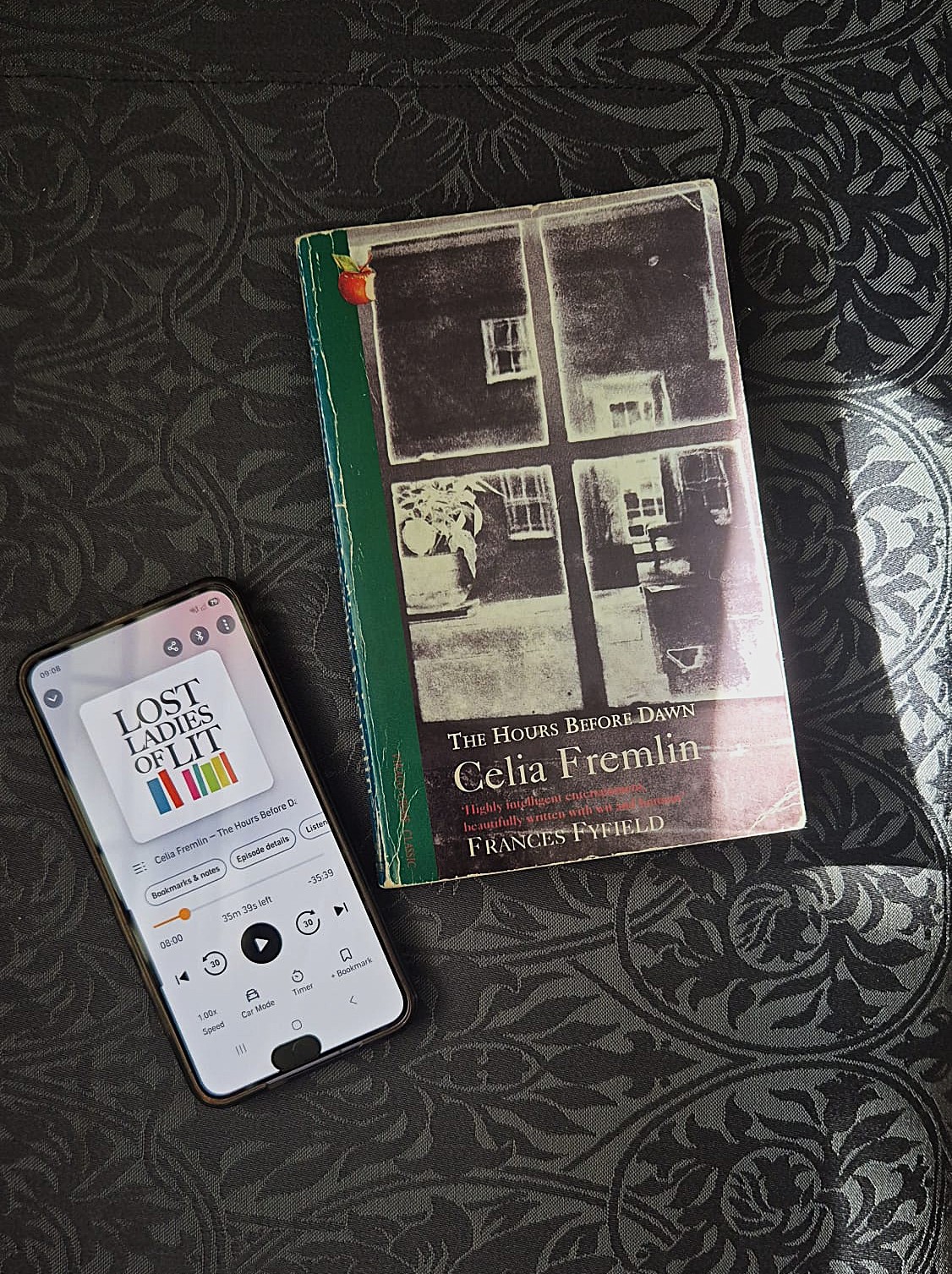
Happy listening alongside my Virago edition of Fremlin’s novel

As I shared with Amy and Kim, I have a very strong memory of discovering my old copy of this 1950s suspense novel – since reissued by Faber – in a second-hand bookshop in East London. What first caught my attention was the arresting title, staring out from the spine. When I drew down the book from the shelf and made a start on the first few pages, I was immediately gripped. The Hours Before Dawn is the story of Louise, a sleep-deprived young mother of three small children, whose already exhausting life is put under even greater pressure when a mysterious lodger comes to live at the family home.

If you haven’t read this fine example of early domestic noir, I urge you to do so – not just for its page-turning plot but also how skilfully its author brings the suburban London of the 1950s to life. I have read Fremlin’s book several times over the years. With each new reading I have taken away different things. However, it was perhaps only when I returned to the book to prepare for the Lost Ladies of Lit episode that I fully appreciated the extent to which Fremlin’s novel had influenced my own approach to writing.

At first glance, the early 2000s Japanese setting of my fiction debut, A Tiny Speck of Black and then Nothing, is very different from the milieu of 1950s London that Fremlin evokes. On the other hand, much of the action of both books revolves around a very particular living space. In my novel it’s Apartment 603 – where Anna and Loll, the main characters, live – situated within a tower block in the bustling heart of the city. In The Hours Before Dawn it’s a terraced house on a quiet residential street. What both locations share is a set of very fixed boundaries, which can at times make them feel as if they are cut off from the rest of the world.

As I reread Fremlin’s novel, what really hit me this time is just how much I’d learned from her technical expertise: how, with the use of strong pacing and carefully controlled revelation of detail, a writer can use domestic settings such as these to enhance atmospheres of strangeness and growing tension.

As it happens, my Lost Ladies of Lit appearance hasn’t been my only chance of late to reflect on authors whose work has influenced me. A couple of weeks ago, I sat down for a chat with Rebekah Lattin-Rawstrone, host of The Hypothetical Bookshelf (‘a Desert Island Discs for books’) for a chat about five books that have shaped me as a reader and writer. The episode will air soon, so I should be able to talk more about it in a future newsletter.

In a final bit of podcast-related news, this month I was pleasantly surprised to hear Amelia Kyazze, author of, most recently, The Cinema on Jósef Boulevard, recommend A Tiny Speck of Black and then Nothing during an episode of Write and Wrong. I was also very happy to spot my novel elegantly photographed on the tea table of popular book blogger, Miranda Mills, whose new release, The Cosy Commonplace Book, is out now in the UK and should shortly be available in the US too. And I was so encouraged by the praise of Instagram reviewer Cornflower Books, who called my novel ‘ thriller-like, cinematic, meticulously observed’ and Ann Kennedy Smith, whose Cambridge Ladies’ Dining Society Substack I love, and who said it was a book she ‘genuinely couldn’t put down’.

Since unputdownable is definitely the way I would describe Fremlin’s The Hours Before Dawn, it was lovely to hear my own book described in similar terms. In addition to the quotes I mention above, I continue to be very moved by the messages and reader reviews I’ve received (on Amazon, GoodReads, Waterstones and elsewhere) from people who have enjoyed my novel. It has been truly wonderful to introduce a few more people to Fremlin’s work this month. In turn, I am enormously appreciative that, thanks to the kind words of my own readers, more people are discovering A Tiny Speck of Black and then Nothing too.

A Tiny Speck of Black and then Nothing is published by Manilla Press in the UK and is available from Blackwell’s, Waterstones, Bookshop.Org, Amazon or your favourite independent bookshop.

The US paperback will be published by Open Road on 10 November and is available for pre-ordering from Barnes & Noble, Bookshop.Org, Amazon and independent bookstores.

The novel is also available as an ebook and as an audiobook, narrated by Jacqui Bardelang.

I was recently announced as the judge of the 2026 Book Edit Writers’ Prize.

I appear on episode 152 of Lost Ladies of Lit ‘Celia Fremlin –The Hours Before Dawn with Emily Midorikawa’

If you would like to make sure you receive my next monthly essay, and others like it, you can sign up for my newsletter here.
Reaching out in the Darkness: Making connections with readers of A Tiny Speck of Black and then Nothing

Regular readers of this newsletter will know that my debut novel came out in the UK in late July. As was the case with my previous (nonfiction) titles, launching A Tiny Speck of Black and then Nothing into the world has been both exhilarating and exhausting.

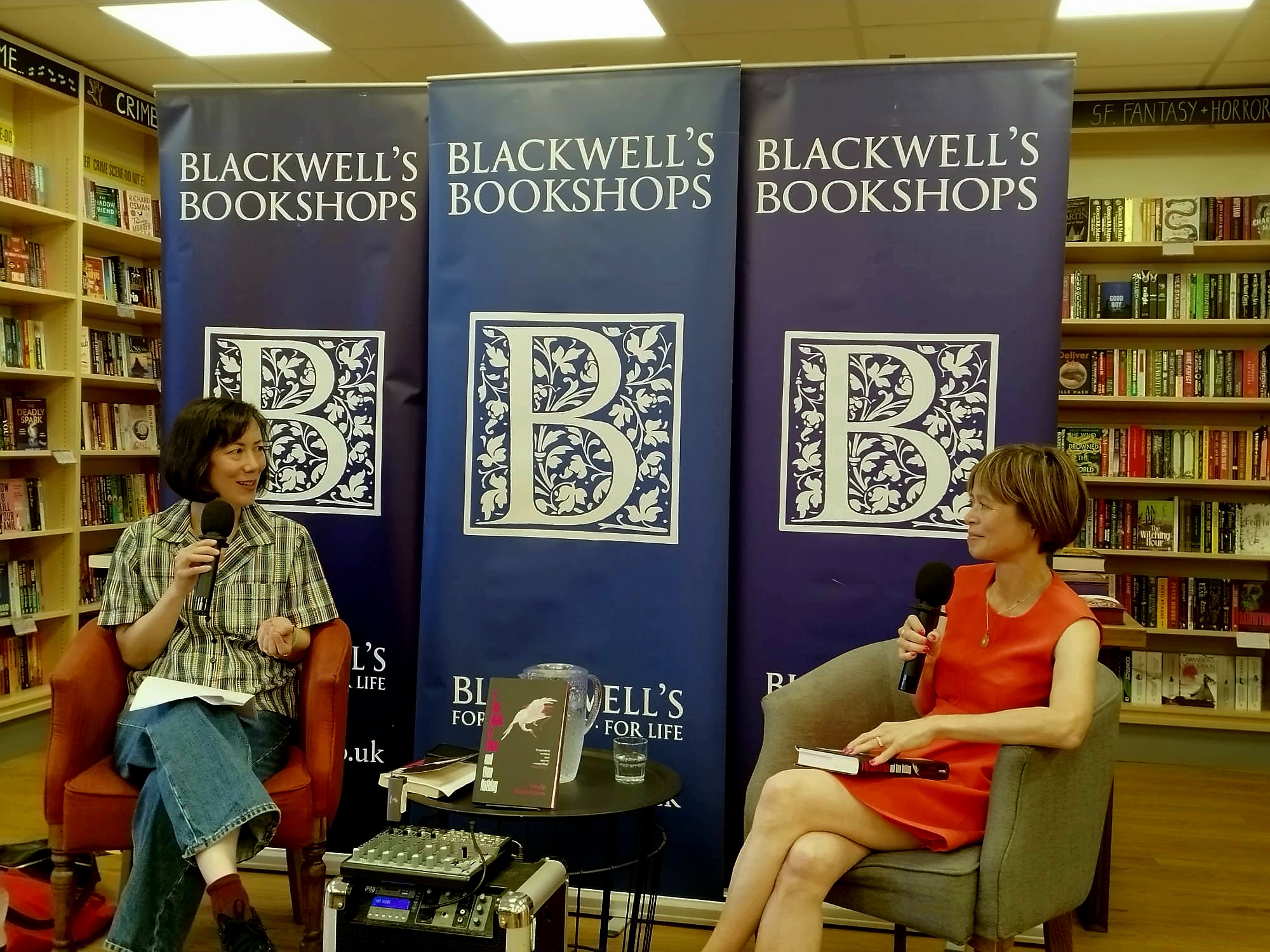
Blackwell’s, Manchester – with Susan Barker, author of Old Soul

The months leading up to and surrounding a book’s publication are frequently filled with the highs of unanticipated joys and excitements and the lows of frustrations about things over which you, the writer, have very little control.

If you’re not careful such difficulties can become overwhelming, so much so that you end up not fully appreciating the best parts of the experience. In the past, I have sometimes been guilty of falling into that trap. This time round then, I made a conscious decision that, come what may, I was going to thoroughly enjoy every good thing that happened.

An online workshop with Creative Courage’s Rachel Connor at the start of the year was very useful in helping me work out how I would stick to my plan. The exercises set by Rachel made me realise that in order to really absorb publication’s best moments I would need to be fully present for them, as opposed to letting my mind wonder to any adjacent worries simmering away.

By throwing myself into the best parts of the experience, I would ultimately come to recognise that one of the most fulfilling aspects of publishing a book for me is the opportunities it brings for making connections with other literature lovers. Such connections can occur on a large scale, or small. Both can be emotionally rewarding.

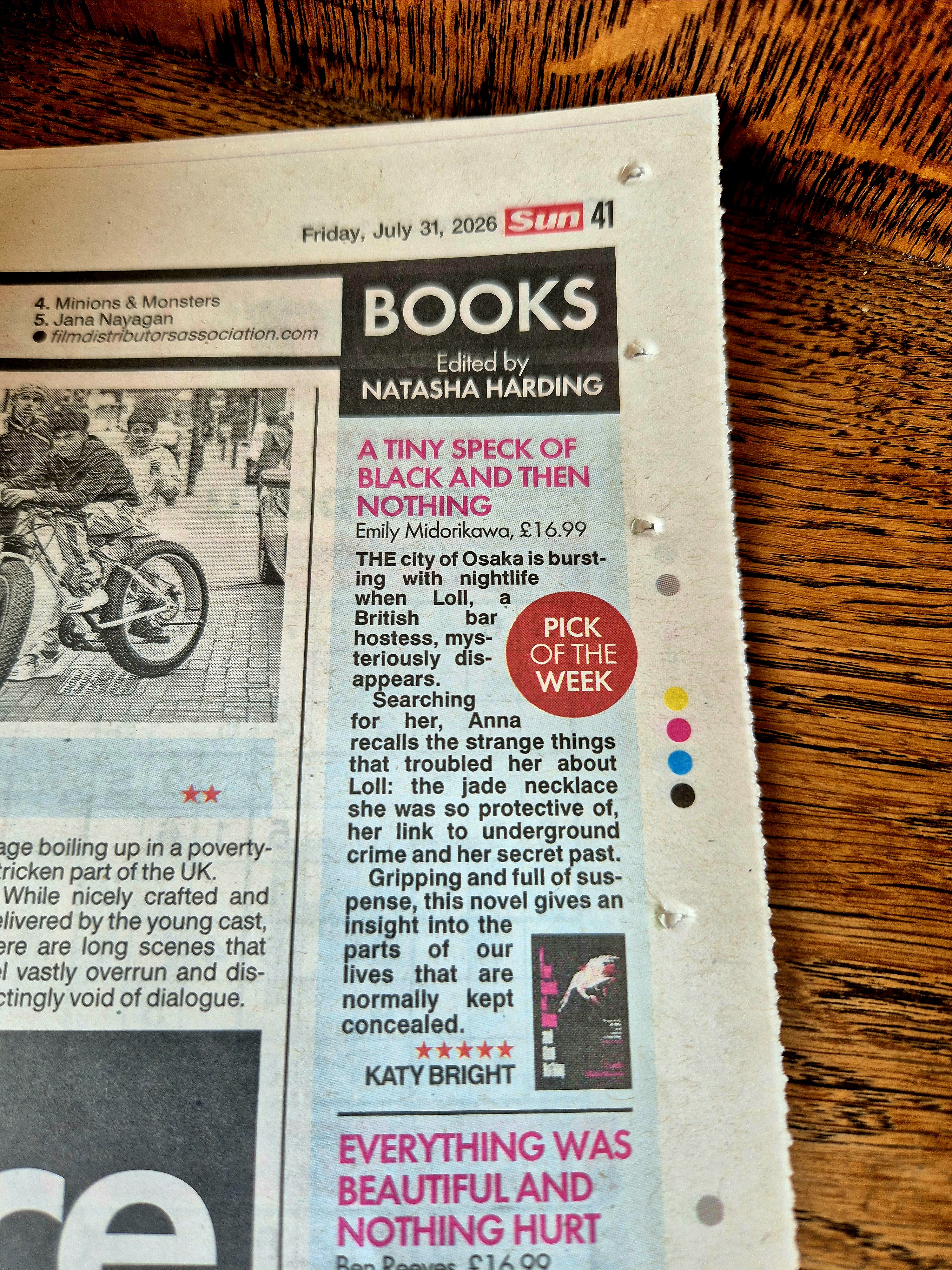
Over the past weeks, for instance, A Tiny Speck of Black and then Nothing has been reviewed in an eclectic mix of British publications. Among these, The Sun newspaper gave it a five-star rating and called it ‘gripping and full of suspense’. The Japan Society Review said the novel ‘eloquently describes that struggle to find one’s way in a land with unfamiliar customs … and the tension that comes with often being on the “outside”’. Elle magazine praised the way the story ‘plunges readers into the nightlife of Osaka’.

It is wonderful to imagine these articles piquing the interest of faraway readers, who might then get hold of a copy of the novel. I am reminded of the words of Harriet Beecher Stowe, whose literary friendship with George Eliot I explored in my first book A Secret Sisterhood (cowritten with Emma Claire Sweeney). Stowe likened a book, from its writer’s point of view, to ‘a hand stretched forth in the dark passage of life to see if there is another hand to greet it’.

Sometimes, of course, especially these days, an author gets to see a bit more of her audience than Stowe’s quote suggests. I’m very grateful to the readers of A Tiny Speck of Black and then Nothing who have shared their views of the story of Anna and Loll online.

These include Linda Hill of Linda’s Book Bag, who called the book ‘fabulous’, ‘intelligently written, intense and intimate’ and Jo Leevers, bestselling author of, most recently, The Museum of Second Chances, who very generously remarked on her Substack that ‘certain sentences are so elegant I had to stop and read them again’. Up and coming novelist and BAFTA-winning producer Joe Evans, too (whose own novel Den launches next year), made an enthusiastic Instagram reel.

Many others have helped spread the word via social media, or left reader reviews on GoodReads, Amazon, Waterstones and other review sites – which is something that really, really helps authors.

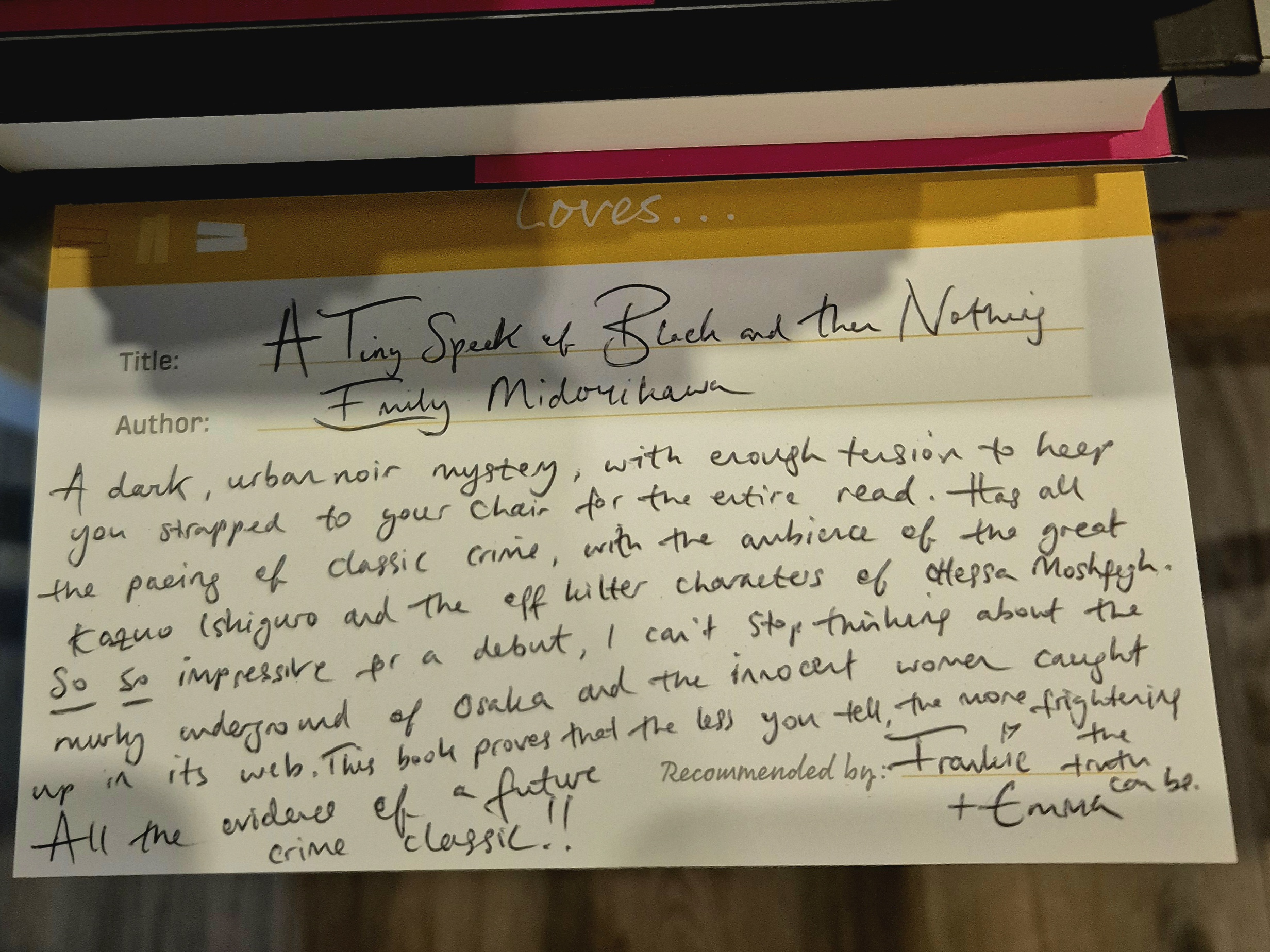
Some reviews were handwritten – booksellers’ review at Collected in Durham, which also hosted an event with me

The forging of connections with fellow book lovers doesn’t only happen online. I’m so happy to have met many readers in person at the various bookshops and libraries I visited on my UK tour – occasions that, perhaps partly due to the promise I’d made to myself at the start of the year, were an absolute joy each time.

Having begun A Tiny Speck of Black and then Nothing close to a quarter of a century ago – at a time when its early-2000s setting was contemporary! – it was astonishing to finally be able to discuss the novel in front of such supportive crowds and in the more intimate settings of the book signings that followed.

But publishing a book isn’t all about building new connections. It’s as much about strengthening links that already exist with organisations and individuals an author has enjoyed working with, or writing for, before.

Two of the authors who interviewed me at my events are writers I admire and also close personal friends: my Secret Sisterhood coauthor Emma Claire Sweeney (at Burley Fisher in London) and Susan Barker, author of Old Soul (at Blackwell’s, Manchester). I was delighted to mark the publication of A Tiny Speck of Black and then Nothing by contributing a guest essay to the website of another writer friend, Sarah Emsley, author of The Austens. I was also recently given the opportunity to return as a guest to one of my favourite podcasts, Lost Ladies of Lit – due to air in September. It was a thrill to chat with Kim Askew and Amy Helmes about the underrated brilliance of Celia Fremlin, whose 1950s domestic noir novel The Hours Before Dawn has been an important literary influence. I have a few more collaborations in the pipeline too, which I’ll look forward to sharing in a future newsletter.

Every bit as important as such public-facing examples, however, are the quieter forms of connection. The old school friend with whom you had long lost touch who messages to say they have read your book. The reader of your previous nonfiction titles who decides to give your novel a go. And just the fact that, though you may never know anything about them, somewhere out there in the darkness – as imagined by Stowe– are people who have read your words and have formed a connection with you.

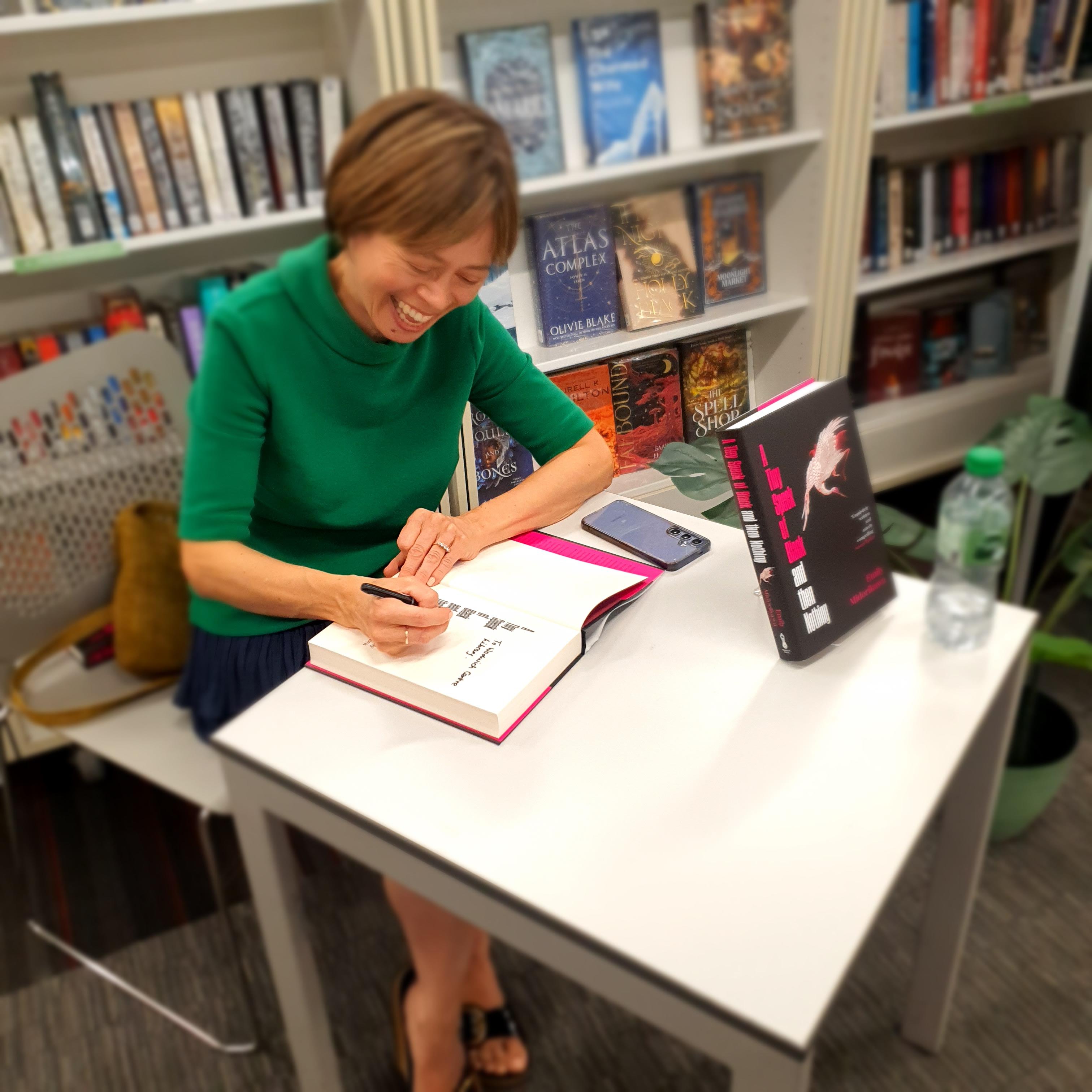
Happily signing books and meeting readers at my Woolwich Centre Library / JET AA event

A Tiny Speck of Black and then Nothing is published by Manilla Press in the UK and is available from Blackwell’s, Waterstones, Bookshop.Org, Amazon or your favourite independent bookshop.

The US paperback will be published by Open Road on 10 November and is available for pre-ordering from Barnes & Noble, Bookshop.Org, Amazon and independent bookstores.

The novel is also available as an ebook and as an audiobook, narrated by Jacqui Bardelang.

A Tiny Speck of Black and then Nothing was recently featured in The Sun (5* review), Elle, My Weekly, the Japan Society Review, Linda’s Book Bag, Jo’s Substack and the Debut Digest.

I wrote a guest post for Sarah Emsley’s website about what this debut novelist learned from writing biography.

If you would like to make sure you receive my next monthly essay, and others like it, you can sign up for my newsletter here.
Out today: A Tiny Speck of Black and then Nothing

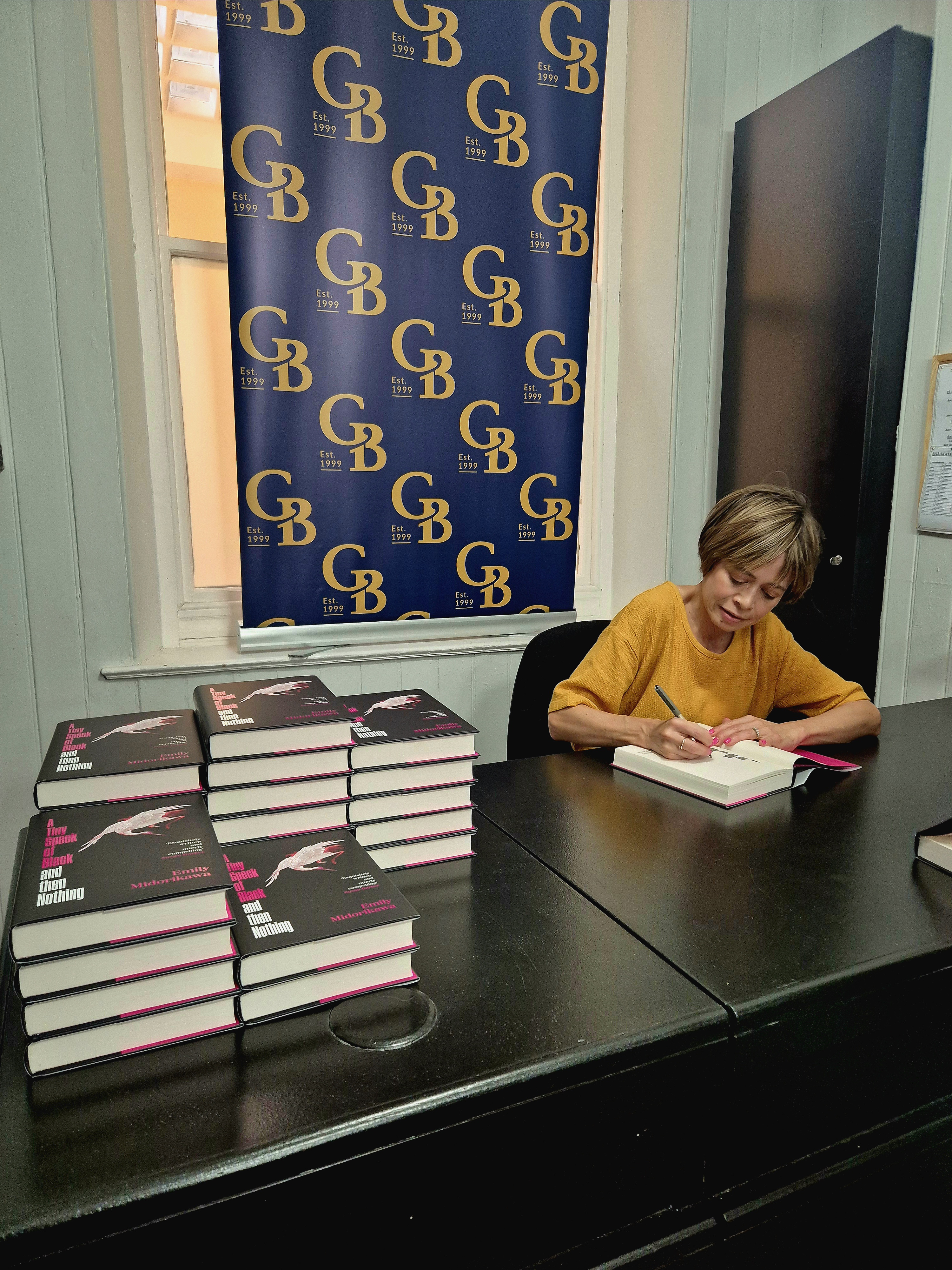
Book signing at London’s Goldsboro Books

It still feels surreal to me that the novel I began close to a quarter of a century ago is finally being published by Manilla Press today! It amazes me that I can now walk into a UK bookshop and pick up a hardback copy of A Tiny Speck of Black and then Nothing. The novel is also available as an ebook and audiobook, beautifully narrated by Jacqui Bardelang.

I’ve spent some very happy hours this week signing copies of my novel at Burley Fisher Books, Goldsboro Books and West End Lane Books in London ahead of today’s official release date. It was also a thrill to launch A Tiny Speck of Black and then Nothing into the world a couple of days early with a pre-publication event at Burley Fisher, chaired by my friend and Secret Sisterhood coauthor, Emma Claire Sweeney.

Since Emma has been a part of my novel’s strange and convoluted journey right from the beginning, when we were both young English language teachers in Japan, it felt particularly apt that she should be the one sitting there with me in that East London bookshop on Tuesday asking me questions about the book and its long and winding course to publication.

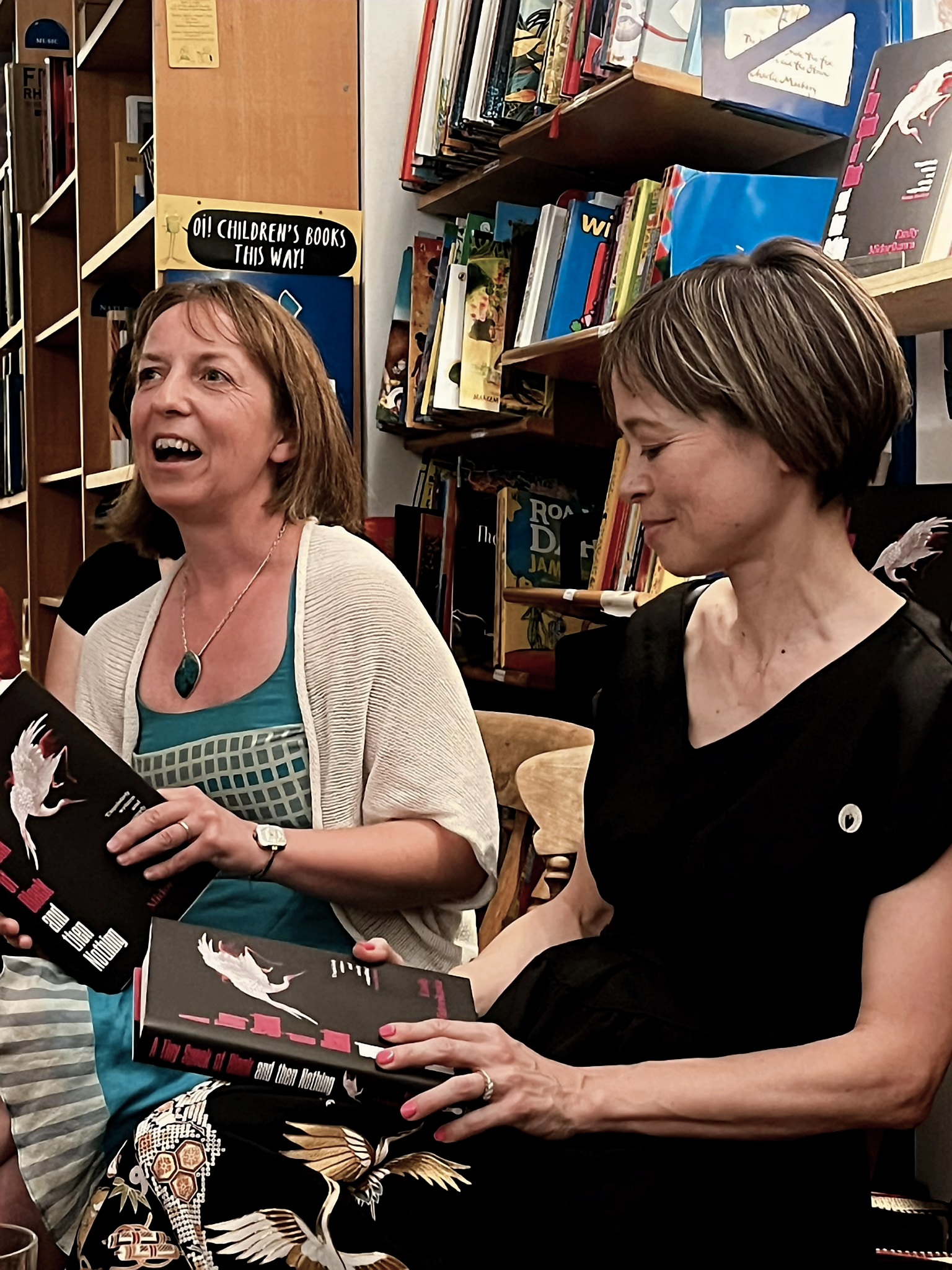
Emma’s engaging interviewing style kept us all entertained at my book launch

As I wrote in a previous newsletter, the two years I spent in Japan as a young woman – and meeting Emma in particular – marked both a personal turning point and the very start of my writing career. And so sitting there in a shop packed with family and friends that evening really felt like the culmination of a very long chapter in my life as well as a new beginning.

Other things I’ve been up to this week include recording an episode for one of my favourite podcasts, Lost Ladies of Lit, to air as part of their next season in September. It was such fun to chat with Kim Askew and Amy Helmes, and to share my passion for the 1950s domestic noir The Hours Before Dawn, which I count as a literary influence. I also took part in the July Bàrd Debuts night at Bàrd Books, at which I shared the stage with other debut novelists: Lorna Elcock, Karishma Jobanputra, Kim Willis, Phil Melanson and Stacey Yu.

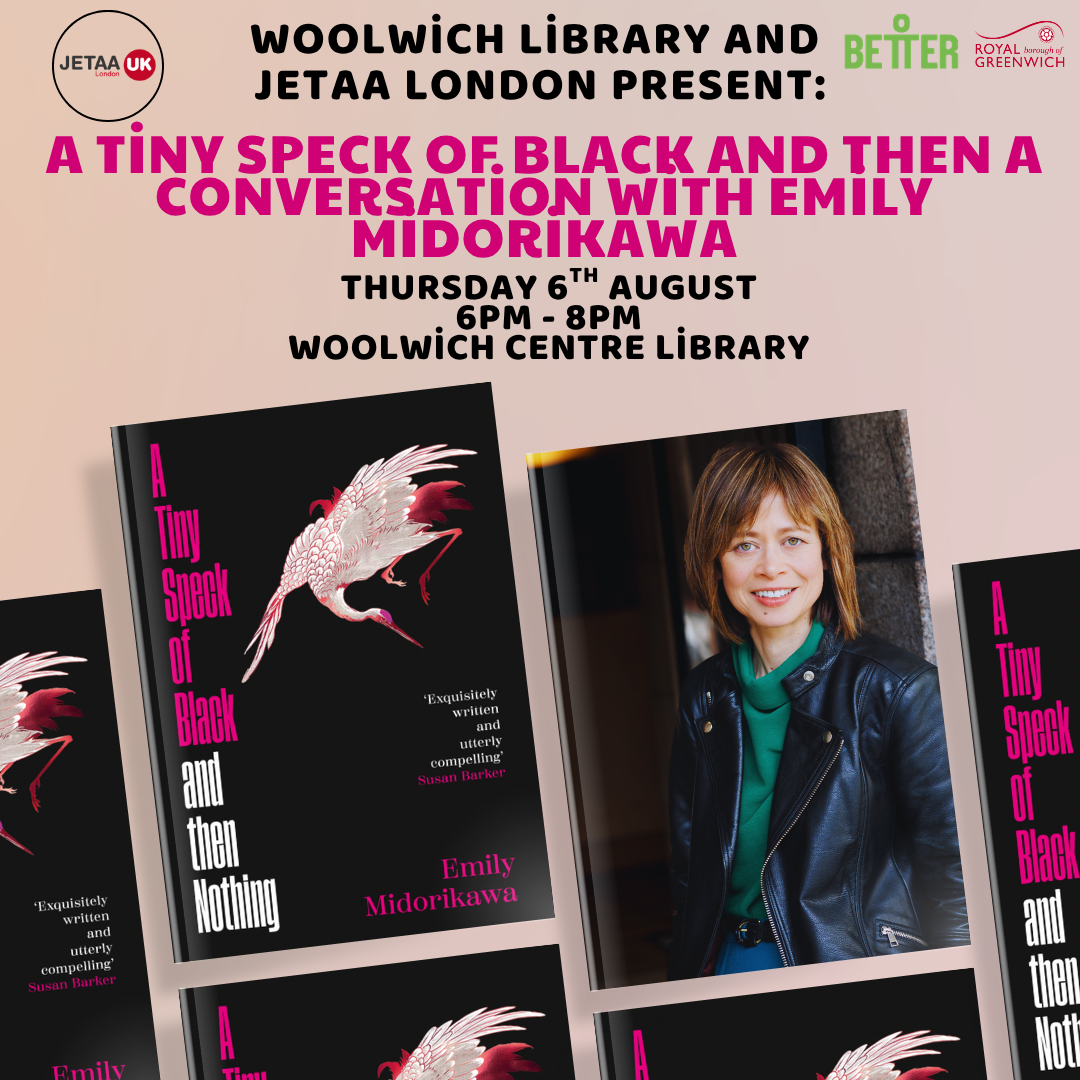
Tonight I’ll be at Blackwell’s in Manchester, where I’ll be in conversation with Susan Barker, author of Old Soul. On Wednesday 29 July I’ll be heading further north for an event at Collected in Durham. I’ll be back in London for a talk at Woolwich Library on Thursday 6 August, co-presented by the JET Alumni Association. If you can make it to any of these events, it would be lovely to see you.

Like Tuesday’s discussion with my longtime friend and writing partner Emma, there is an element of things coming full circle with the Woolwich Library event in particular.

The two years I spent living and working in Japan in my twenties were organised by the JET Programme. If I had not applied for this scheme, I would not have met Emma; I would quite possibly never experienced living in the country in which my mother grew up; would most certainly never have written A Tiny Speck of Black and then Nothing. Perhaps I will have the chance to reflect on some of these things on 6 August in Woolwich. Either way, I am definitely looking forward to this event.

If you can’t make it to any of my live talks, but would be interested in finding out a bit more about A Tiny Speck of Black and then Nothing and the story behind it, you might want to take a look at this video conversation between me and the author and creative coach Rachel Connor. I’ll be sharing more news of video and audio content in my future newsletters, as well as getting back to the usual essay style of these postings next month.

For now, I’d like to take the opportunity to thank everyone who has supported my novel at different stages along the way. That includes all the individuals and organisations mentioned in this post, plus my literary agent Ariella Feiner and editor Zoe Yang who were in it for the long haul, my friends and family, and every single person who’s taken the time to buy a copy or spread the word about A Tiny Speck of Black and then Nothing. It may sound trite, but I mean it sincerely: your encouragement really has meant the world to me.

A Tiny Speck of Black and then Nothing is published by Manilla Press and is available as a hardback, ebook and audiobook. In the UK, copies are available from Blackwell’s, Waterstones, Bookshop.Org, Amazon or your favourite independent bookshop.

The US e-book, published by Open Road on 4 August, is available for pre-ordering from Barnes & Noble, Bookshop.Org, Amazon and independent bookstores. The US paperback will be released in November and will be available for pre-ordering soon. (The audiobook is already available in the US and Canada, as it is elsewhere.)

Tickets for these upcoming events are available at the following links: Blackwells, Manchester (Thursday 23 July), Collected in Durham (Wednesday 29 July) and ‘A Tiny Speck of Black and then a Conversation with Emily Midorikawa’ presented by Woolwich Library & JET AA in London (Thursday 6 August).

A Tiny Speck of Black and then Nothing was included in the Crib Notes Hot Mum Summer Reading List 2026.

If you would like to make sure you receive my next monthly essay, and others like it, you can sign up for my newsletter here.