A Chance Discovery that Shaped Me as a Writer (and quite a lot about podcasts)

I’m delighted to have been asked to judge the 2026 Book Edit Writers’ Prize, which is open for entries from British/UK-based writers until 16 October. The prize is aimed at unpublished novelists from backgrounds and communities currently underrepresented in UK publishing. The full eligibility criteria and details of how to enter can be found here. I also recently answered some questions from prize founder Emily Pedder about my career to date and what I’ll be looking for in this year’s submissions

You can read the whole interview here, but right now I want to reflect on my response to just one question. When Emily asked me about my most important advice for emerging writers, I didn’t have to hesitate. ‘Read,’ I said. ‘Read for enjoyment, but also read with a writer’s eye.’ There really is so much a writer can learn by studying the work of other authors – although it’s the kind of learning that may go unnoticed at first, especially when one is in the thrall of a book.

Recently, I had the enjoyable opportunity to reflect on a book that’s made an important mark on both my reading and writing lives. Being a great fan of the Lost Ladies of Lit podcast, it was a thrill to open the new season with hosts Kim Askew and Amy Helmes for a discussion about The Hours Before Dawn by Celia Fremlin.
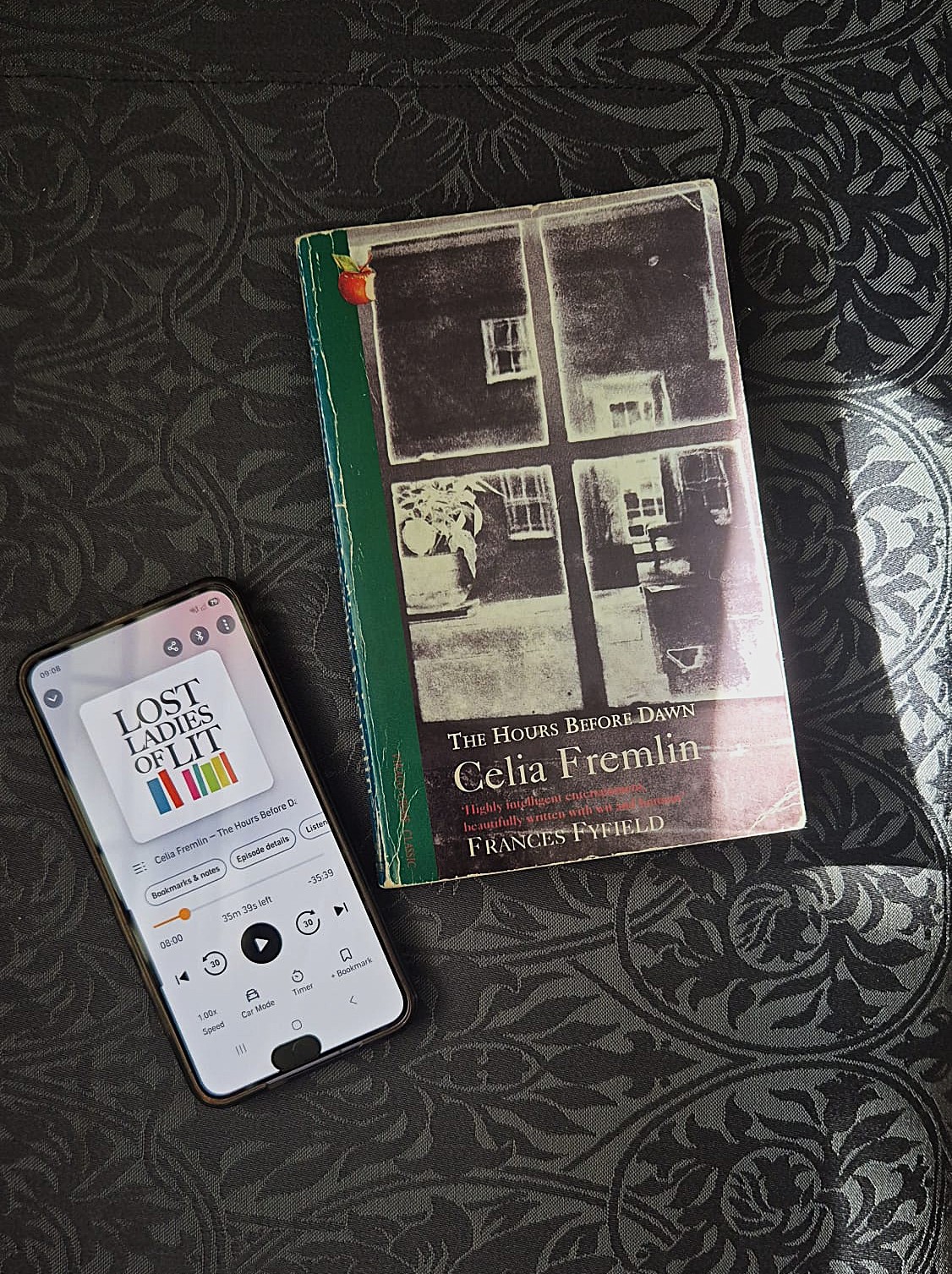
Happy listening alongside my Virago edition of Fremlin’s novel

As I shared with Amy and Kim, I have a very strong memory of discovering my old copy of this 1950s suspense novel – since reissued by Faber – in a second-hand bookshop in East London. What first caught my attention was the arresting title, staring out from the spine. When I drew down the book from the shelf and made a start on the first few pages, I was immediately gripped. The Hours Before Dawn is the story of Louise, a sleep-deprived young mother of three small children, whose already exhausting life is put under even greater pressure when a mysterious lodger comes to live at the family home.

If you haven’t read this fine example of early domestic noir, I urge you to do so – not just for its page-turning plot but also how skilfully its author brings the suburban London of the 1950s to life. I have read Fremlin’s book several times over the years. With each new reading I have taken away different things. However, it was perhaps only when I returned to the book to prepare for the Lost Ladies of Lit episode that I fully appreciated the extent to which Fremlin’s novel had influenced my own approach to writing.

At first glance, the early 2000s Japanese setting of my fiction debut, A Tiny Speck of Black and then Nothing, is very different from the milieu of 1950s London that Fremlin evokes. On the other hand, much of the action of both books revolves around a very particular living space. In my novel it’s Apartment 603 – where Anna and Loll, the main characters, live – situated within a tower block in the bustling heart of the city. In The Hours Before Dawn it’s a terraced house on a quiet residential street. What both locations share is a set of very fixed boundaries, which can at times make them feel as if they are cut off from the rest of the world.

As I reread Fremlin’s novel, what really hit me this time is just how much I’d learned from her technical expertise: how, with the use of strong pacing and carefully controlled revelation of detail, a writer can use domestic settings such as these to enhance atmospheres of strangeness and growing tension.

As it happens, my Lost Ladies of Lit appearance hasn’t been my only chance of late to reflect on authors whose work has influenced me. A couple of weeks ago, I sat down for a chat with Rebekah Lattin-Rawstrone, host of The Hypothetical Bookshelf (‘a Desert Island Discs for books’) for a chat about five books that have shaped me as a reader and writer. The episode will air soon, so I should be able to talk more about it in a future newsletter.

In a final bit of podcast-related news, this month I was pleasantly surprised to hear Amelia Kyazze, author of, most recently, The Cinema on Jósef Boulevard, recommend A Tiny Speck of Black and then Nothing during an episode of Write and Wrong. I was also very happy to spot my novel elegantly photographed on the tea table of popular book blogger, Miranda Mills, whose new release, The Cosy Commonplace Book, is out now in the UK and should shortly be available in the US too. And I was so encouraged by the praise of Instagram reviewer Cornflower Books, who called my novel ‘ thriller-like, cinematic, meticulously observed’ and Ann Kennedy Smith, whose Cambridge Ladies’ Dining Society Substack I love, and who said it was a book she ‘genuinely couldn’t put down’.

Since unputdownable is definitely the way I would describe Fremlin’s The Hours Before Dawn, it was lovely to hear my own book described in similar terms. In addition to the quotes I mention above, I continue to be very moved by the messages and reader reviews I’ve received (on Amazon, GoodReads, Waterstones and elsewhere) from people who have enjoyed my novel. It has been truly wonderful to introduce a few more people to Fremlin’s work this month. In turn, I am enormously appreciative that, thanks to the kind words of my own readers, more people are discovering A Tiny Speck of Black and then Nothing too.

A Tiny Speck of Black and then Nothing is published by Manilla Press in the UK and is available from Blackwell’s, Waterstones, Bookshop.Org, Amazon or your favourite independent bookshop.

The US paperback will be published by Open Road on 10 November and is available for pre-ordering from Barnes & Noble, Bookshop.Org, Amazon and independent bookstores.

The novel is also available as an ebook and as an audiobook, narrated by Jacqui Bardelang.

I was recently announced as the judge of the 2026 Book Edit Writers’ Prize.

I appear on episode 152 of Lost Ladies of Lit ‘Celia Fremlin –The Hours Before Dawn with Emily Midorikawa’

If you would like to make sure you receive my next monthly essay, and others like it, you can sign up for my newsletter here.

Calling aspiring novelists: deadline for applications to the Novel Studio

Novel StudioAs a current tutor at City University’s Novel Studio, I want to remind anyone interested that the deadline for applications is fast approaching.

The Novel Studio offers fifteen selected students the opportunity to work on their novels-in-progress in twice-weekly evening sessions that run over three terms. The course guides participants through the tricky terrain of novel writing, from plotting, planning and research through to character development, pacing, narrative voice and style, revisions and editing. The module I am teaching this term is “The Publishing Industry” and it culminates in an end-of-year reading event to friends of the students involved as well as invited industry guests.

As a tutor, I have been really impressed by the standard of work produced by the group this year, and also their serious level of commitment to the novels they are writing. If you are interested in applying for 2013/14, here’s what you need to do:

Email 2,000 words of your own fiction (short story or novel extract) and a copy of your CV to Emily.Pedder.1@city.ac.uk. Alternatively, you can post your work to the following address:

Emily Pedder
Course Director
The Novel Studio
City University London
Enterprise Office
Northampton Square
London EC1V OHB

The deadline is 30 May 2013. For more information, please see the applications page of the City website.

Good luck!

Next year’s Mslexia Writer’s Diary

The Mslexia diary I’d ordered arrived this week. As usual, in addition to all the calendar-related stuff you’d expect, it contains inspiring words by writers, a useful directory and summary of The Writing Year ahead, and plenty of blank pages for scribbling down ideas.

The diary’s theme in 2013 is collaboration and the Inspirations page for August focuses on the writing friendship between Emma Claire Sweeney and I, which we talked about in our feature in The Times back in May and also in our recent discussion panel at the NAWE conference.

Also mentioned in our Mslexia entry are Jill Dawson, Louise Doughty, Emily Pedder and Monique Roffey, who were amongst the writers we interviewed for the Times article.

NAWE conference talk: The Writing Friendship

Having had such an enjoyable time at last year’s NAWE conference, I was really happy to take part in another panel discussion there this year. This time,  Emma Claire Sweeney and I  gave a presentation on the subject of friendships between writers along with two other “writing friends”, Emily Pedder and Monique Roffey.

Some people might remember that Emily and Monique were two of the writers we interviewed for our feature in The Times

Emily Midorikawa and Emma Claire Sweeney

back in May. Taking the newspaper article as a starting point, we used our session at the conference to ask Monique and Emily some questions inspired by what they’d told us the last time we met with them.

Emma and I were also able to delve a little further into the friendships of  some of the historical writers that our research for the article had centred on  – Brontë and Gaskell, Fitzgerald and Hemingway, Mansfield and Woolf to name but a few – as well as discussing practical tips with our audience of modern day writers for ways of sustaining a successful writing friendship through the good as well as the rockier times.

Having been friends with Emma for well over a decade now, I feel extremely lucky to have someone who’s been with me through my writing years. As we shared with the group at the conference, there have been ups and downs in the trajectories of our careers, disappointments as well as triumphs, but something I really do appreciate is that Emma’s been there for the whole of this period and that she’s still usually the first person I turn to if I have a difficult decision to make or a knotty plot problem that I’m struggling to untangle.

Feature in The Times today

In celebration of this year’s Orange Prize, The Times is running a feature article on friendships between female writers, written by Emma Claire Sweeney and me.

Emma introducing me at a recent readings event at NYU in London

For this piece, we had the pleasure of travelling out to Ireland to interview Anne Enright (shortlisted this year for The Forgotten Waltz) and her friend Lia Mills. Back in London, we met with Jill Dawson and Louise Doughty, both former Orange nominees who’ve long been a source of support to each other), and also Emily Pedder and Monique Roffey (shortlisted in 2010). These two signed a co-mentoring agreement to keep themselves on track with the writing of their memoirs.

The inspiration for this article grew out of personal experience. Emma and I have been the best of friends since we met, in Japan, over a decade ago. We were working as English teachers in Japanese schools at the time. Separately, we were writing in secret, although we hadn’t yet found the courage to admit our ambitions, even to each other. Since then, we’ve been able to watch each other’s careers progress and we’ve shared in the successes and also the disappointments we’ve experienced so far. It’s been wonderful to talk with other women who’ve relied on each other in similar ways.

Many thanks to Anne, Emily, Jill, Lia, Louise and Monique. Thanks also to Tim Clare and Joe Dunthorne for your insights on a friendship between two male writers. This story is also featured in our piece.

Finally, thanks to Emma herself. Despite the long hours we’ve put into this, working with you has been just as fun as it always is.

The Novel Studio at City University

The Novel Studio (formerly known as The Certificate in Novel Writing) will be running at City University London from autumn 2012. This will be a three-term, year-long course, that aims to guide fifteen selected students through the various aspects of writing a novel, as well as preparing them for work with agents and editors.

I am thrilled to have been asked to teach modules in terms two and three (Workshop One and The Publishing Industry) and to be working, once again, with my good friend Emma Sweeney as well as Emily Pedder and Kirstan Hawkins.

If you think you or someone you know might be interested, I encourage you to find out more from the City University website. Or if you have any questions you think I could answer, do please get in touch using the Contact Emily tab on the home screen.