Reaching out in the Darkness: Making connections with readers of A Tiny Speck of Black and then Nothing

Regular readers of this newsletter will know that my debut novel came out in the UK in late July. As was the case with my previous (nonfiction) titles, launching A Tiny Speck of Black and then Nothing into the world has been both exhilarating and exhausting.
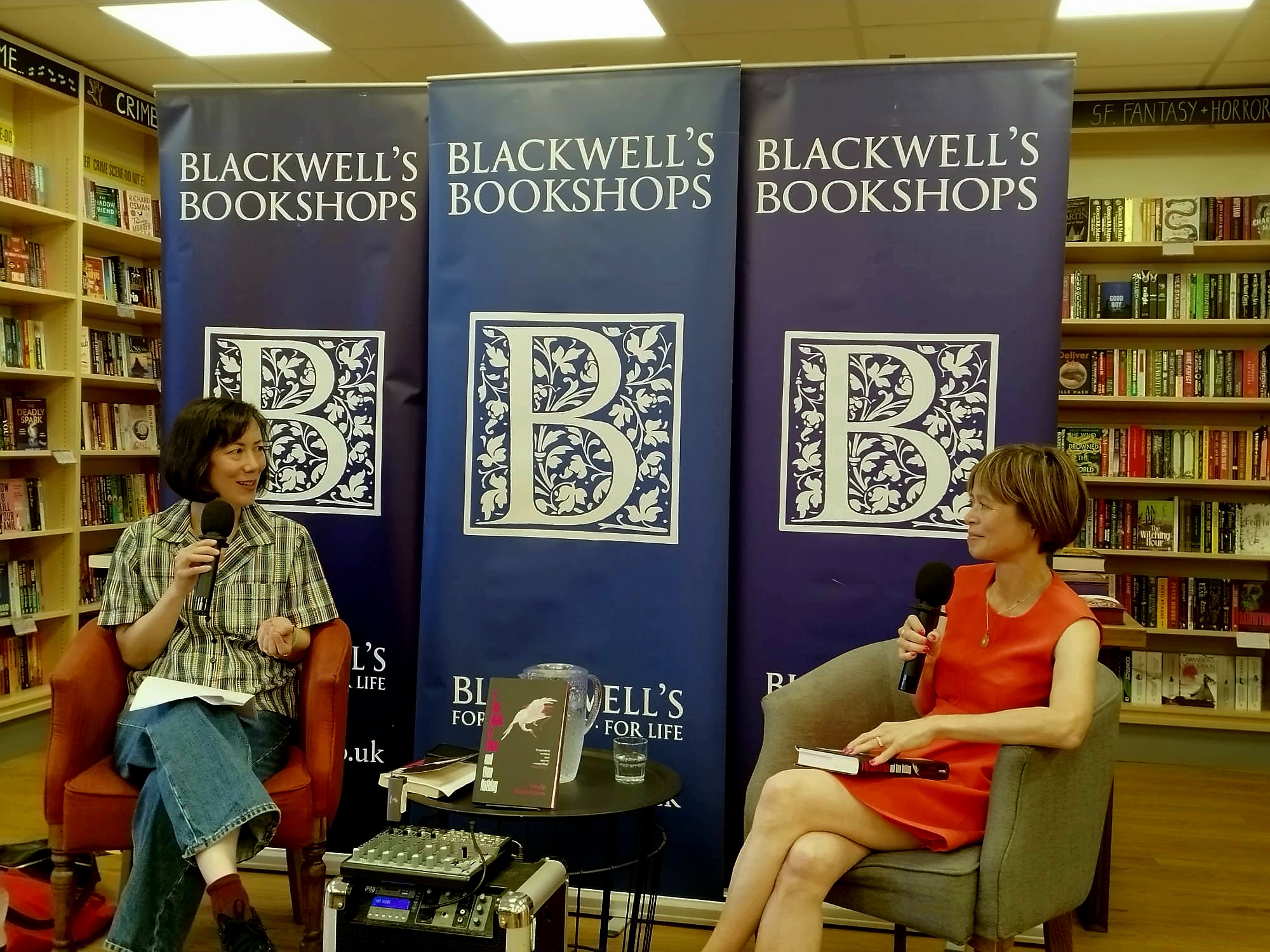
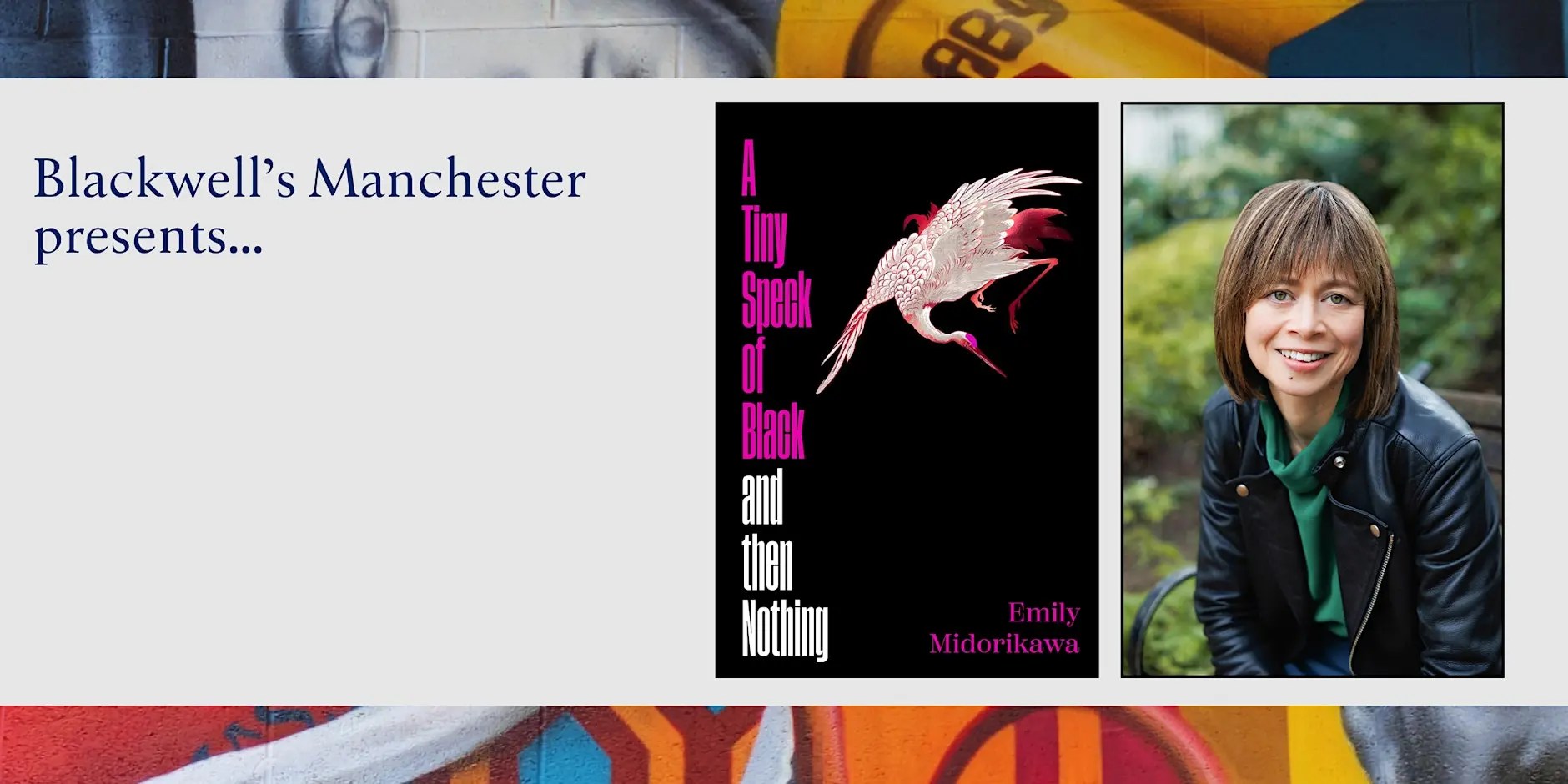
Blackwell’s, Manchester – with Susan Barker, author of Old Soul

The months leading up to and surrounding a book’s publication are frequently filled with the highs of unanticipated joys and excitements and the lows of frustrations about things over which you, the writer, have very little control.

If you’re not careful such difficulties can become overwhelming, so much so that you end up not fully appreciating the best parts of the experience. In the past, I have sometimes been guilty of falling into that trap. This time round then, I made a conscious decision that, come what may, I was going to thoroughly enjoy every good thing that happened.

An online workshop with Creative Courage’s Rachel Connor at the start of the year was very useful in helping me work out how I would stick to my plan. The exercises set by Rachel made me realise that in order to really absorb publication’s best moments I would need to be fully present for them, as opposed to letting my mind wonder to any adjacent worries simmering away.

By throwing myself into the best parts of the experience, I would ultimately come to recognise that one of the most fulfilling aspects of publishing a book for me is the opportunities it brings for making connections with other literature lovers. Such connections can occur on a large scale, or small. Both can be emotionally rewarding.
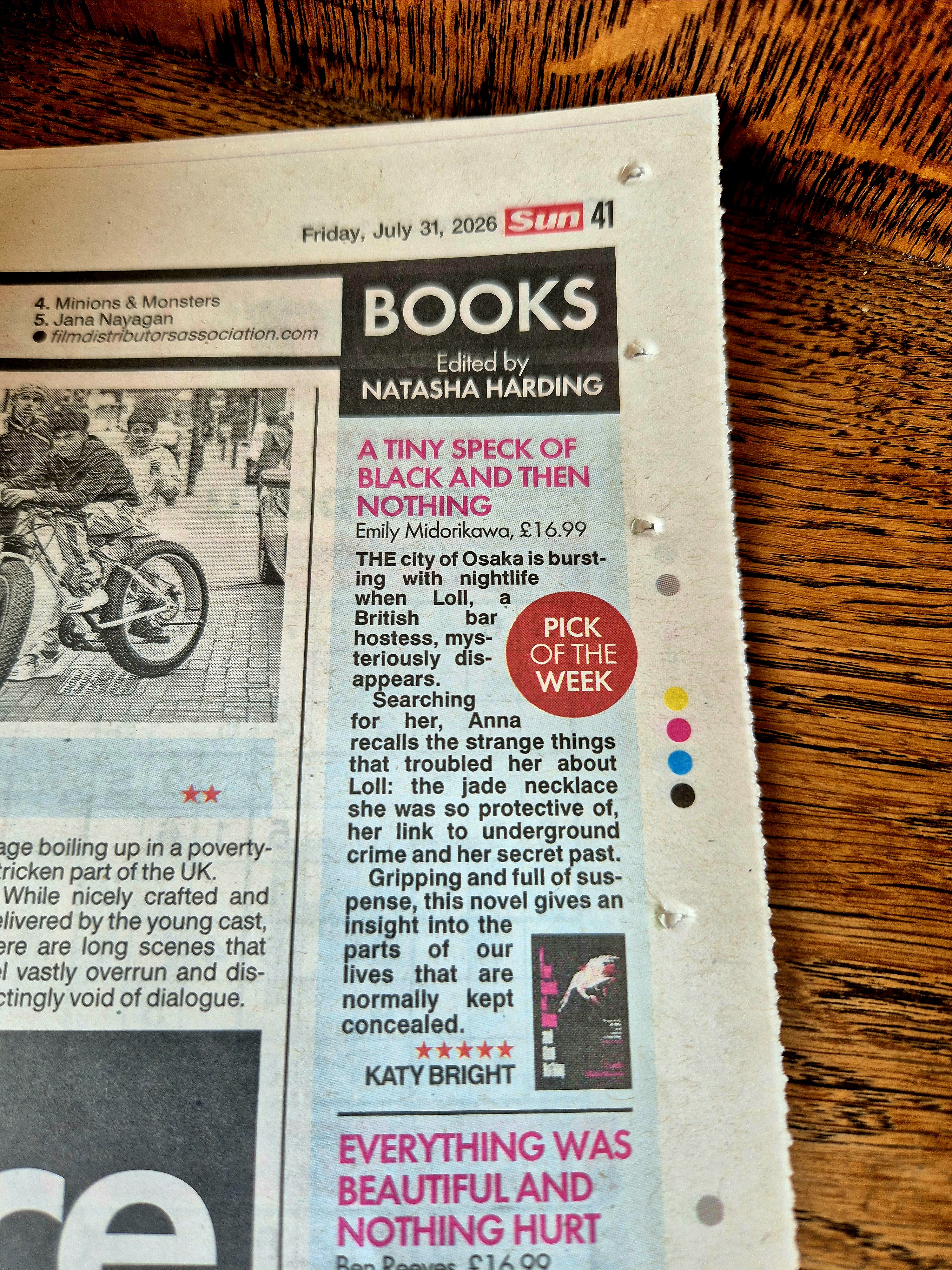
Over the past weeks, for instance, A Tiny Speck of Black and then Nothing has been reviewed in an eclectic mix of British publications. Among these, The Sun newspaper gave it a five-star rating and called it ‘gripping and full of suspense’. The Japan Society Review said the novel ‘eloquently describes that struggle to find one’s way in a land with unfamiliar customs … and the tension that comes with often being on the “outside”’. Elle magazine praised the way the story ‘plunges readers into the nightlife of Osaka’.

It is wonderful to imagine these articles piquing the interest of faraway readers, who might then get hold of a copy of the novel. I am reminded of the words of Harriet Beecher Stowe, whose literary friendship with George Eliot I explored in my first book A Secret Sisterhood (cowritten with Emma Claire Sweeney). Stowe likened a book, from its writer’s point of view, to ‘a hand stretched forth in the dark passage of life to see if there is another hand to greet it’.

Sometimes, of course, especially these days, an author gets to see a bit more of her audience than Stowe’s quote suggests. I’m very grateful to the readers of A Tiny Speck of Black and then Nothing who have shared their views of the story of Anna and Loll online.

These include Linda Hill of Linda’s Book Bag, who called the book ‘fabulous’, ‘intelligently written, intense and intimate’ and Jo Leevers, bestselling author of, most recently, The Museum of Second Chances, who very generously remarked on her Substack that ‘certain sentences are so elegant I had to stop and read them again’. Up and coming novelist and BAFTA-winning producer Joe Evans, too (whose own novel Den launches next year), made an enthusiastic Instagram reel.

Many others have helped spread the word via social media, or left reader reviews on GoodReads, Amazon, Waterstones and other review sites – which is something that really, really helps authors.
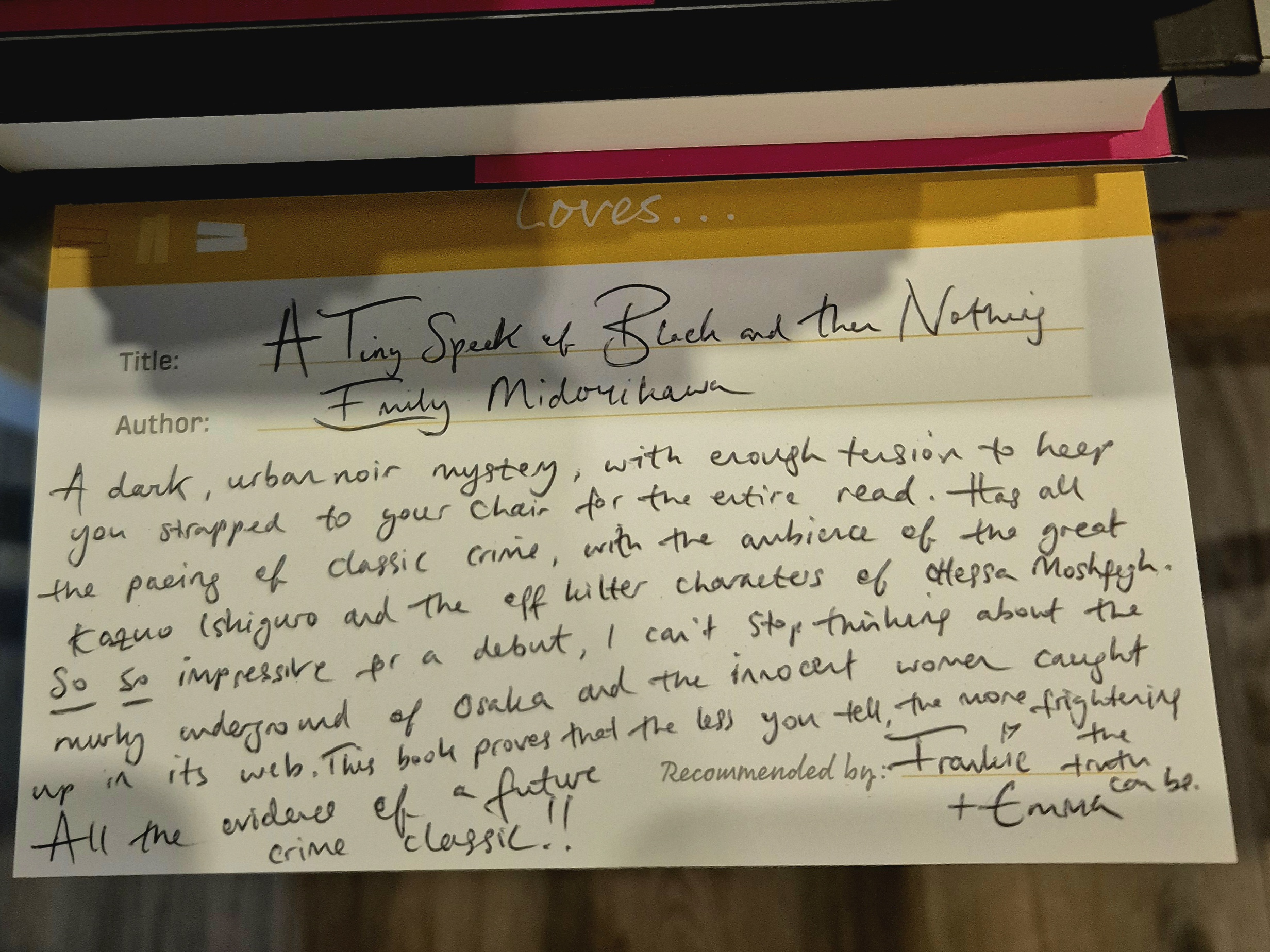
Some reviews were handwritten – booksellers’ review at Collected in Durham, which also hosted an event with me

The forging of connections with fellow book lovers doesn’t only happen online. I’m so happy to have met many readers in person at the various bookshops and libraries I visited on my UK tour – occasions that, perhaps partly due to the promise I’d made to myself at the start of the year, were an absolute joy each time.

Having begun A Tiny Speck of Black and then Nothing close to a quarter of a century ago – at a time when its early-2000s setting was contemporary! – it was astonishing to finally be able to discuss the novel in front of such supportive crowds and in the more intimate settings of the book signings that followed.

But publishing a book isn’t all about building new connections. It’s as much about strengthening links that already exist with organisations and individuals an author has enjoyed working with, or writing for, before.

Two of the authors who interviewed me at my events are writers I admire and also close personal friends: my Secret Sisterhood coauthor Emma Claire Sweeney (at Burley Fisher in London) and Susan Barker, author of Old Soul (at Blackwell’s, Manchester). I was delighted to mark the publication of A Tiny Speck of Black and then Nothing by contributing a guest essay to the website of another writer friend, Sarah Emsley, author of The Austens. I was also recently given the opportunity to return as a guest to one of my favourite podcasts, Lost Ladies of Lit – due to air in September. It was a thrill to chat with Kim Askew and Amy Helmes about the underrated brilliance of Celia Fremlin, whose 1950s domestic noir novel The Hours Before Dawn has been an important literary influence. I have a few more collaborations in the pipeline too, which I’ll look forward to sharing in a future newsletter.

Every bit as important as such public-facing examples, however, are the quieter forms of connection. The old school friend with whom you had long lost touch who messages to say they have read your book. The reader of your previous nonfiction titles who decides to give your novel a go. And just the fact that, though you may never know anything about them, somewhere out there in the darkness – as imagined by Stowe– are people who have read your words and have formed a connection with you.
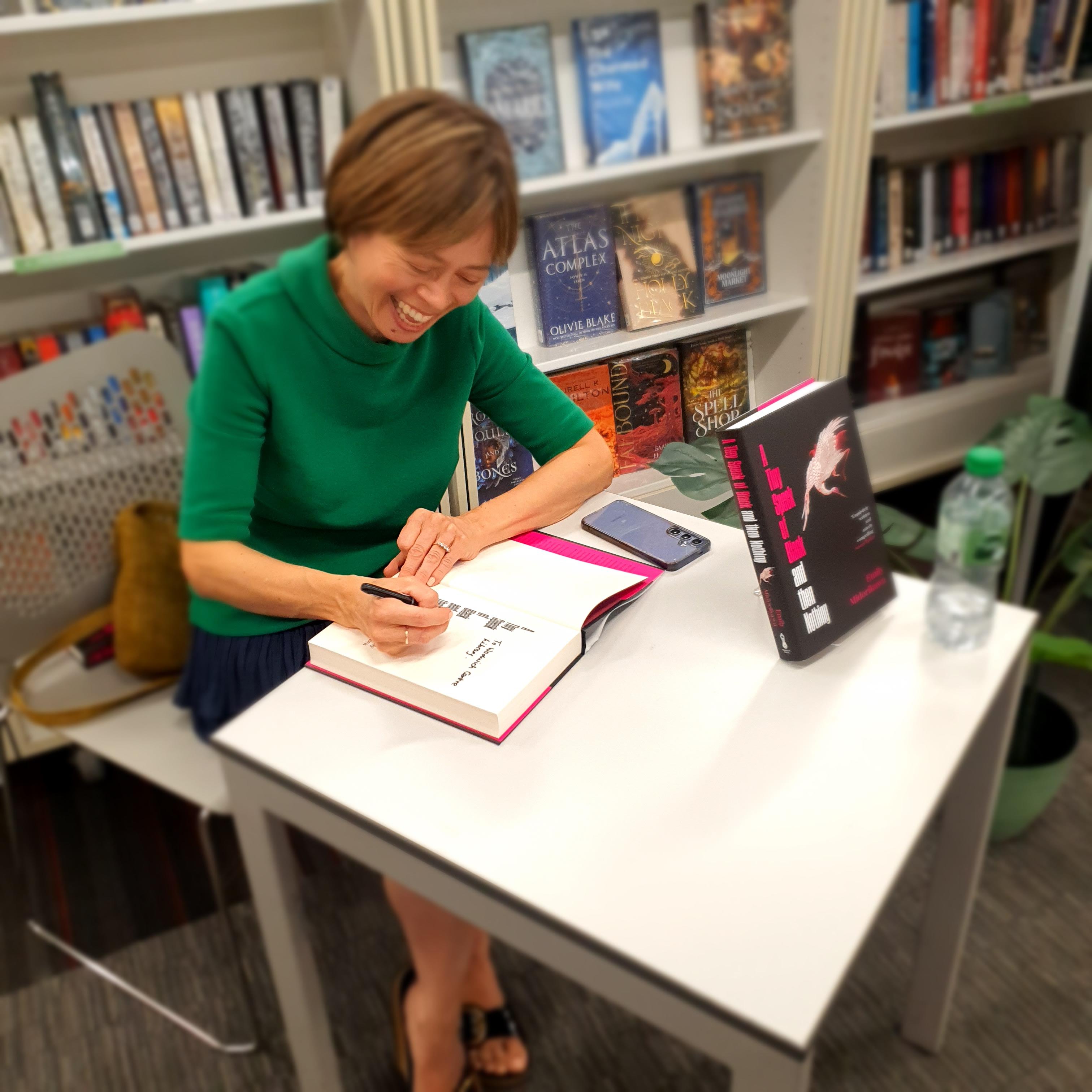
Happily signing books and meeting readers at my Woolwich Centre Library / JET AA event

A Tiny Speck of Black and then Nothing is published by Manilla Press in the UK and is available from Blackwell’sWaterstonesBookshop.OrgAmazon or your favourite independent bookshop.

The US paperback will be published by Open Road on 10 November and is available for pre-ordering from Barnes & Noble, Bookshop.OrgAmazon and independent bookstores.

The novel is also available as an ebook and as an audiobook, narrated by Jacqui Bardelang.

A Tiny Speck of Black and then Nothing was recently featured in The Sun (5* review), Elle, My Weekly, the Japan Society Review, Linda’s Book Bag, Jo’s Substack and the Debut Digest.

I wrote a guest post for Sarah Emsley’s website about what this debut novelist learned from writing biography.

If you would like to make sure you receive my next monthly essay, and others like it, you can sign up for my newsletter here.
The Long and Winding Road to Publication

There are just under three months to go until A Tiny Speck of Black and then Nothing, the novel I began over twenty years ago, will be published in the UK. I’ll be back in Britain for much of the summer and will be marking publication day with an event at Blackwell’s, Manchester on Thursday 23 July. I will be in conversation with Susan Barker, author of the highly acclaimed literary horror novel Old Soul among other brilliant books.

I still sometimes struggle to comprehend that I am in this position at all – preparing to speak at public events about a novel I’d once thought would never see the light of day. Tickets are available here. If you can make it to Manchester, I would love to see you at Blackwell’s!

As I wrote last month, I began writing A Tiny Speck of Black and then Nothing when I was in my early twenties and working as an English language teacher in Japan. After returning to the UK, aged 23, I initially moved back to the town where I grew up, took a part-time secretarial job that left me ample time to keep working on my novel, and began applying to university creative writing programmes.

Following an acceptance to UEA’s famous MA course, I packed the bag containing my laptop and the loose printed pages of my novel-in-progress with a great deal of nervous excitement. But my time at UEA, though wonderful in many ways, would turn out to be more emotionally difficult than I’d anticipated.

Halfway through the year, my father died. Losing him when I was still only in my mid-twenties, had a profound effect on me. Afterwards I never felt young in the same way again, and, looking back, I can see how the grief I felt transformed the way I wrote about loss in my book.

By the time I left UEA, I had a scrappy first draft. An extract published in that year’s course anthology attracted the interest of a couple of literary agents, but it didn’t lead to any formal offers of representation, much less to a publishing deal.

Still, I kept going, (mostly) firm in my belief that – although aspects of my novel still needed lots of work – I had a story worth telling. Eventually, a different agent took me on and, after revising the manuscript extensively with her, I steeled myself as it went out on mass submission to publishers. Some editors showed an interest in the book’s urban Japanese setting; my depictions of hostess bars; and the central storyline of an intense friendship between two young women, one of whom suddenly disappears. But, although I seemed to get close on a few occasions, it didn’t lead to a publishing contract.

By this stage, I had been living with A Tiny Speck of Black and then Nothing for a long time – around eight years in fact. Having already committed so much time and energy to the novel, it was very difficult to put it aside. Dejectedly, I did, though, to concentrate on other writing projects, including various collaborations with Emma Claire Sweeney, whose friendship – as I described in my March post – has been of the utmost importance to me.

In 2012, my mother died. I was 32, still relatively young to have lost both my parents. Again, as in the case of my dad’s passing, the long shadow cast by Mum’s death would go on to affect the ways in which I approached the theme of loss in my novel when I unexpectedly found myself returning to work on it some years into the future.

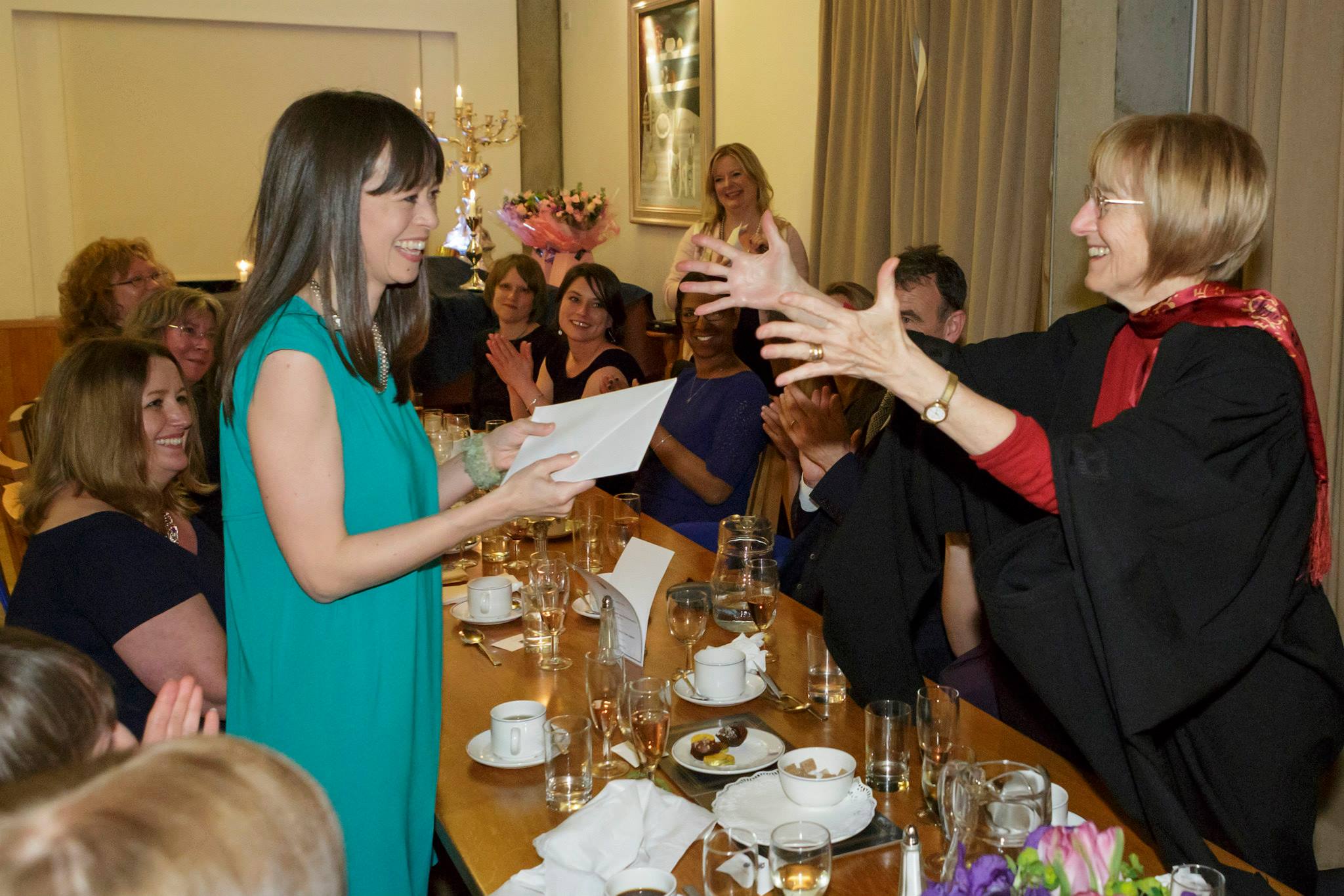
During the decade and more when A Tiny Speck of Black and then Nothing largely languished in a metaphorical bottom drawer, I occasionally dusted off the draft to enter it into competitions for unpublished writers. My novel had some success with the SI Leeds Literary Prize and Yeovil Literary Prize. Then in 2015, it made the shortlist for the influential Lucy Cavendish Fiction Prize. At that year’s prize ceremony, to which I took Emma as my guest, I was stunned to hear my name announced as the winner.

Being announced as the 2015 winner of the Lucy Cavendish Fiction Prize by Professor Janet Todd OBE
(Image courtesy of Lucy Cavendish College)

It is hard to overstate the impact of these small victories on my confidence at a time when my belief that A Tiny Speck of Black and then Nothing would ever be published was at an all-time low. These wins opened doors, offered unexpected opportunities and led to lasting friendships with fellow shortlistees and other people associated with the awards.

Such prizes also helped me to be taken more seriously when I was pitching proposals for my two nonfiction books, A Secret Sisterhood (cowritten with Emma Claire Sweeney) and Out of the Shadows, published in 2017 and 2021 respectively. Both were historical group biographies. I relished the research and writing of these works, but after Out of the Shadows came out I decided that I wanted to give fiction another go.

As the mother of two small children by then, my progress was slow and steady. But I had begun a new novel when, completely out of the blue, in early 2024, I received word from my agent that that an editor who’d read the manuscript of A Tiny Speck of Black and then Nothing some time ago was asking if it was still available.

In the years since she had begun representing me as a writer, my agent (whose commitment to this novel has been extraordinary) had continued to show my manuscript to editors from time to time. As before, some had shown an interest but nothing had ever worked out. So, although I was happy for this editor to take another look at the work, I didn’t hold out much hope.

You can imagine my amazement then when, two decades after I first began writing my novel, I found myself signing a publishing contract at last – and being faced with the somewhat daunting prospect of returning, in mid-life, to a book I originally conceived as a young woman.

The process of revising the manuscript for publication has been surprising, challenging and illuminating – and more than a little uncanny at times. There has also been pleasure in meeting the writer I once was on the page, and in the realisation that the passage of time has, in fact, enriched the story I am able to tell.

In May, I will explore what it’s like to come back to a creative work after a long break.  If you would like to make sure you receive this next monthly post, and others like it, you can sign up for my newsletter here.
A Tiny Speck of Black and then Nothing will be published by Manilla Press on 23 July 2026 and is available for pre-ordering now.

Tickets for my Blackwells, Manchester event with Susan Barker are available here.